
Last updated November 15, 2026
 AC repair
 Furnace & heating
 Heat pumps
 Ductless mini splits
 Carrier
 Trane
 Goodman
Seasonal tune-up and full diagnostic on your Carrier, Trane, or Goodman system - readings shown to you before any repair is proposed
Diagnosis first, numbers second - you approve the repair price before a single part goes in.
Get your free estimateHow to Hire an HVAC Contractor in Coral Springs: A Step-by-Step Guide
Here’s the uncomfortable truth about hiring HVAC in Coral Springs: a contractor can be fully licensed, widely praised in reviews, and still hand you a system that’s the wrong size for your home. Nothing in Florida’s licensing exam tests whether the technician standing in your hallway actually ran a Manual J load calculation before ordering equipment. Licensing proves someone passed a test. It says nothing about whether the proposal in front of you is built on math or on a rule of thumb. That gap is where homeowners lose money – not from criminals, but from ordinary shortcuts taken by ordinary companies. This guide teaches you to read between the lines of quotes, proposals and contractor behavior before anyone touches your equipment. You’ll learn what to ask, what to verify in Broward County, and how to compare two quotes fairly without a spreadsheet full of guesswork.
Quick Answer
To hire an HVAC contractor in Coral Springs, verify state licensing and insurance first, then demand a written quote that includes a Manual J load calculation, a duct assessment and itemized SEER2 and warranty terms. Compare quotes on those specifics, not sticker price. Ask who pulls the permit and whether any work is subcontracted, and walk away from “like-for-like replacement” language that skips duct evaluation entirely.
Styles & brands we work with
- AC repair
- Furnace & heating
- Heat pumps
- Ductless mini splits
- Carrier
- Trane
- Goodman
Table of Contents
- Why a Manual J Load Calculation Should Outrank Every Other Line in a Quote
- Reading Proposal Language: Red Flags That Hide the Real Work
- How to Verify Licensing, Insurance and EPA 608 Certification in Coral Springs
- The Subcontracting Questions Most Homeowners Never Ask
- Comparing Multi-Brand Quotes Apples-to-Apples: SEER2, Warranty and Labor Coverage
- What Brand Fluency Means on a Service Call vs. a Sales Call
- Ten Questions to Ask Before You Sign
- Common Mistakes to Avoid
Why a Manual J Load Calculation Should Outrank Every Other Line in a Quote
A Manual J load calculation is a room-by-room measurement of how much heat your house gains and loses, and it determines the correct system size. If a quote doesn’t mention it, the contractor is guessing – or copying the tonnage off your old condenser. Those are not the same thing. An oversized system in South Florida short-cycles: it blasts cold air, shuts off before it can dehumidify properly, and leaves interior rooms sticky while the front of the house feels like a freezer. An undersized system runs constantly and never quite catches up in a July afternoon thunderstorm. Both problems trace back to a number nobody checked.
Here’s the frustrating part. Two quotes can list the same 3-ton system at the same price, and only one of them is actually correct for your home. The calculation accounts for window orientation, ceiling height, insulation, ductwork condition and – critically in Coral Springs – the humidity load that most of the country never has to think about. A house near the edge of the Everglades preserve and a two-story on a shaded interior street can carry very different loads even when they look identical from the street.
How to Ask for Proof
- Ask directly: “Did you run a Manual J, and can I see the report?” A legitimate contractor will hand it over without flinching.
- Look for room-by-room figures, not a single total. A one-page summary with one number is not a load calculation.
- Ask whether the report used your actual window and insulation values or the software defaults. Defaults are better than nothing but not much.
- Confirm the recommended tonnage matches what the report says. If the report says 2.5 tons and the quote says 3, ask why.
- Ask for a Manual D too if ductwork is being replaced. That’s the duct sizing calculation, and it matters as much as the equipment.
Any contractor who brushes off a load calculation as unnecessary overhead is telling you something important. They’re not going to run one for you, and their sizing is going to be an educated guess at best. If you’re weighing new equipment, our AC installation page covers what a properly sized install looks like from start to finish.
Reading Proposal Language: Red Flags That Hide the Real Work
The most dangerous phrase in an HVAC quote is “like-for-like replacement.” It sounds reassuring – they’ll swap your old unit for the same size and you’re done. What it actually means, in most cases, is that the contractor is skipping the duct evaluation, the load calculation and any conversation about whether the existing system was ever right for the house. You could be paying to reproduce a mistake that was made thirty years ago.
Read every proposal for these specific word clusters. They aren’t automatically dishonest, but each one should trigger a follow-up question.
- “Existing ductwork to be reused as-is.” Ask what condition it’s in. Leaky ducts in a Coral Springs attic can throw away a meaningful share of your cooling before it ever reaches a room.
- “System sized per existing equipment.” That’s another way of saying no load calculation was run.
- “Permits by others.” This means you, the homeowner, are responsible for pulling the permit. Ask why.
- “Electrical modifications by others.” The same problem, and it can leave you coordinating a second trade on your own.
- “Standard installation” with no listed scope. Vague scope clauses let contractors add charges later for line-set replacement, pad work or disconnect boxes.
- No line-item labor warranty terms. The equipment warranty and the labor warranty are two different promises made by two different parties.
- “As needed” or “if necessary” anywhere near a price. These phrases armor a quote against accountability.
What a Good Proposal Actually Contains
A proposal worth taking seriously will name the equipment model and tonnage, list the SEER2 rating, state who pulls the permit, describe ductwork evaluation and any planned modifications, spell out the equipment and labor warranty periods separately, and include the load calculation as an attachment. It’ll also have a final price and a start date. Anything less isn’t really a quote – it’s an estimate with an asterisk.
How to Verify Licensing, Insurance and EPA 608 Certification in Coral Springs
HVAC work in Florida sits under a state-issued license, and Broward County contractors must carry it to pull permits. Verifying that is straightforward, and skipping it is how homeowners end up with an unpermitted install they discover years later when they try to sell the house.
Step 1: Check the State License
The Florida Department of Business and Professional Regulation runs a free license lookup. Search by the company name and confirm the license is state-certified (the “CAC” prefix denotes air conditioning) and currently active. A contractor licensed for maintenance but not installation will still show up in the database – check the license class, not just the status. Ask for the license number on the proposal itself, not just the business card.
Step 2: Confirm Insurance and Workers’ Comp
Ask for a certificate of insurance and call the insurer listed on it to confirm it’s active. General liability covers your home if something is damaged. Workers’ compensation covers the crew if someone is injured on your property – without it, an injury during an install can become your problem. Don’t accept a verbal yes. Ask for the document.
Step 3: Understand What EPA 608 Actually Covers
EPA Section 608 is a federal certification for handling refrigerants, and every technician who touches the refrigerant circuit must hold it. It’s not a license. It’s not a measure of installation skill. It doesn’t say anything about load calculations, duct design or warranty ethics. When a contractor advertises EPA 608 certification, they’re telling you the technician can legally recover and charge refrigerant. That’s a real and necessary credential. It is not the whole story, and treating it as if it were is how homeowners get lulled.
Step 4: Check the Permit
In Coral Springs, the city’s building department issues HVAC permits and inspects the work. Ask who pulls the permit and get the permit number once it’s issued. Remove the “by others” language from any proposal before signing. If you’re searching for a licensed contractor directly, we’re glad to talk through credentials and scope – Clover AC Repair works on both heating and cooling equipment and can tell you exactly what the job requires.
The Subcontracting Questions Most Homeowners Never Ask
Subcontracting is normal in HVAC, and it isn’t a red flag on its own. What matters is whether you know about it before signing, because the people who actually show up on your property determine the quality of the finished work – and the warranty behind it. A contractor who brings in an electrician for a disconnect box is fine. A contractor who hands the entire install to an unknown crew and never inspects it is a different situation.
- Who pulls the permit? The licensed contractor whose name appears on the permit is responsible for the work. If a third party pulls the permit, ask why.
- Who actually performs the install? Is it the company’s own technicians or a subcontractor? If subcontractors, are they licensed and insured?
- Who handles the electrical work? Most HVAC installs require some electrical modification. That work usually requires a licensed electrician. Ask whether the HVAC contractor coordinates this or leaves it to you.
- Who attends the inspection? If a permit is pulled, the city will inspect. Confirm that the contractor handles the inspection scheduling and any correction work.
- Whose warranty covers the install? A labor warranty from the general contractor is worthless if they subcontracted the install and are now pointing fingers.
Ask these questions in writing, not over the phone. A contractor confident in their process will answer all five plainly. One who gets defensive about them is telling you something.
Comparing Multi-Brand Quotes Apples-to-Apples: SEER2, Warranty and Labor Coverage
Comparing three HVAC quotes in Coral Springs is the moment most homeowners make their biggest mistake – they look at the total price numbers and pick the middle one. That’s not a comparison. Here’s what to line up side by side.
SEER2 Rating
SEER2 is the current efficiency standard, and it replaced the old SEER number in 2023. Higher SEER2 systems cost more up front and use less energy over their life. In South Florida’s cooling season – which is most of the year, realistically – the difference in monthly bills between a low-SEER2 and high-SEER2 system adds up faster than in a milder climate. The right number depends on your usage, not on a contractor’s preference.
Equipment Warranty
The equipment manufacturer warrants the parts and components for a stated number of years. That warranty is typically contingent on registering the system, and on the installation meeting manufacturer specifications. A sloppy install can void it. Read the warranty terms in the proposal, and ask whether the contractor will register the equipment on your behalf.
Labor Warranty
This is the one most homeowners forget. The equipment warranty covers the parts. The labor warranty – the promise that if something fails, someone will come out and fix it without charging you – is the contractor’s separate commitment. Compare the length and scope of labor warranties directly. A five-year labor warranty on a mid-grade system may be worth more than a slightly higher SEER2 rating on a bare-minimum warranty.
Side-by-Side Comparison Table (as a checklist)
- Equipment brand and model number: recorded for each quote
- System size in tons: matched to the Manual J result
- SEER2 rating: listed on the AHRI certificate, not just the brochure
- Equipment warranty length: in years, with registration confirmed
- Labor warranty length: in years, in writing
- Ductwork scope: reused, sealed, modified or replaced
- Permit responsibility: named contractor
- Subcontractors listed: electrical, etc.
- Start date and estimated duration: specified
- Final price: written, not verbal
If two quotes can’t be filled into this format, one of them isn’t a real quote. The equipment brand matters too, but not the way most companies frame it. A properly sized and installed Rheem, York, Daikin or Bryant system will outperform a mis-sized system from any other brand – every time. Brand matters less than sizing and installation quality.
What Brand Fluency Means on a Service Call vs. a Sales Call
When you call an HVAC company for a repair, the technician is either fluent in your brand or they aren’t. Brand fluency means the technician has worked on your model before, knows the failure points, and doesn’t need to consult a manual while charging you an hourly diagnostic. That matters more than which brand you own, because every major manufacturer has quirks – controls that behave differently, parts that fail earlier, service access that’s easier on some models than others.
Our technicians have up to 13 years of experience and are trained on nine of the industry’s most widely installed brands, including Carrier, Trane, Lennox, Goodman, Rheem, York, Daikin, Bryant and American Standard. That’s not a list we recite to impress you – it’s the practical reality of running a brand-neutral service business. Because we don’t have a manufacturer rebate program pushing a particular line, our recommendation is based on your home and your budget. Nine major brands, zero brand bias. If a technician recommends a replacement, it’s because the equipment is failing, not because a specific model needs to move. That’s what repair-or-replace clarity actually looks like from the homeowner’s side of the conversation.
For heating, that same brand-neutral approach applies. Our furnace repair and replacement work covers the equipment that’s actually installed in South Florida homes, where gas furnaces and heat pumps both show up. One call for both sides of your system. You don’t need a separate heating contractor and air conditioning contractor – Coral Springs homeowners get both from one number.
Ten Questions to Ask Before You Sign
Write these down and ask them of every contractor you’re considering. The answers will separate the professionals from the sales departments fast.
- Did you run a Manual J, and will you share the report? A working contractor will say yes without hesitation.
- What license class do you hold, and what’s the number? Get it on the proposal, not just the business card.
- Who pulls the permit? If the answer isn’t the contractor, ask why.
- Who performs the install – your technicians or a subcontractor? If it’s the latter, ask for their licensing.
- Will you evaluate the existing ductwork, and how? A proper evaluation includes a visual inspection and static pressure measurement, at minimum.
- What are the equipment and labor warranty terms in writing? Two different promises, both in scope.
- Will you register the equipment warranty for me? Improper registration can void coverage.
- What’s the SEER2 rating on the specific model you’re quoting? Ask for the AHRI certificate, not the sales sheet.
- What’s the start date, and what’s the estimated duration? Install timing depends on equipment availability – vague answers mean you’re waiting on their schedule, not yours.
- Can I see the full scope on paper before I sign? If they can’t produce it, they don’t have one.
Any contractor who dodges even a couple of these is signaling how they’ll behave if something goes wrong after the install. The questions aren’t hostile – they’re the ones every technician who respects their work will answer without puffing up.
Common Mistakes to Avoid
- Choosing on price alone. The lowest quote in Coral Springs often means the shortest labor warranty and a system sized by eyeball. You’ll pay for that shortcut every month for the life of the equipment.
- Accepting “like-for-like replacement” without asking about ductwork. Replacing the box without evaluating the ducts is like putting a new engine in a car with bald tires. Ask what’s happening to the duct system before signing.
- Treating EPA 608 as if it were a contractor license. It’s a refrigerant handling certification. It’s necessary and it’s not a license. Verify the state license separately.
- Letting the contractor skip the load calculation because “the old one was the same size.” The old one might have been wrong. That’s the whole reason for the calculation.
- Not asking who pulls the permit. Unpermitted work in Coral Springs can surface at inspection or sale, and correcting it is expensive. The permit also protects you – it means someone with authority looked at the install.
- Forgetting to register the equipment warranty. Many manufacturer warranties are void without registration. Ask the contractor to confirm in writing that they’ll handle it.
- Comparing quotes that use different efficiency ratings or warranty lengths. A $500 difference between two systems with different SEER2 and labor warranties isn’t a $500 difference. Fill out the comparison checklist before deciding.
See the difference
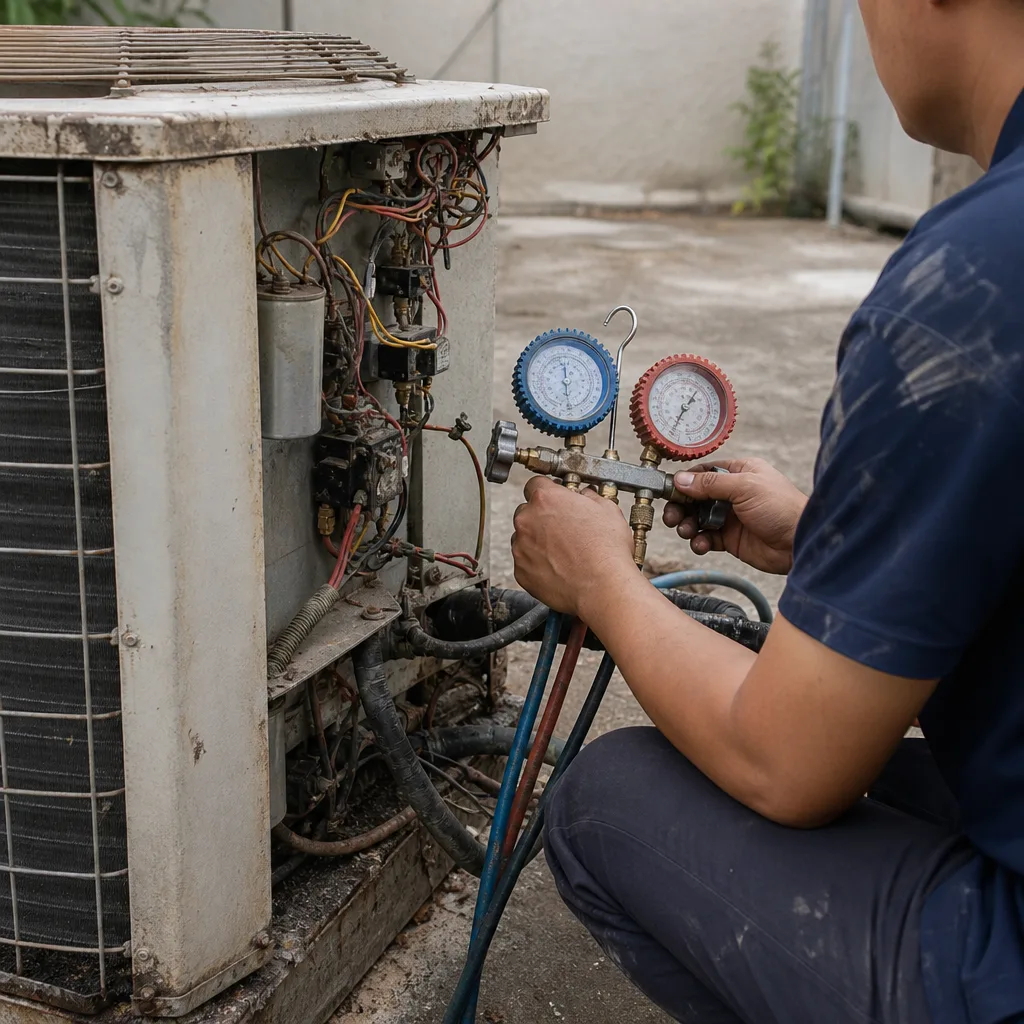 Before
 After
 Before
 After
 Before
 After
When to Call a Professional
Some HVAC situations are worth a call immediately. Any refrigerant leak, any burning smell from equipment, any system that’s tripping the breaker, any sign of electrical arcing or scorching at a disconnect or panel – those are safety issues and shouldn’t wait. A gas furnace that isn’t heating, smells faintly of gas, or makes a rumbling or popping sound on startup is also a call-now situation. So is a system that’s frozen on the indoor coil and won’t thaw, or an AC that’s running constantly but can’t hold the temperature on a Coral Springs afternoon.
Repairs, diagnostics, load-calculated system replacements and honest repair-or-replace conversations are what we do. Clover AC Repair offers free estimates in Coral Springs – call (833) 501-2993. We answer 24/7. Fast dispatch from 7am to 7pm, Sunday through Friday.
Frequently Asked Questions
Search the Florida Department of Business and Professional Regulation’s license lookup by company name, then confirm the license is active and the class covers installation (not just maintenance). Ask for the license number on the written proposal, not just the business card. Call the number if you’re unsure – the lookup is free and takes a minute. For an exact quote from a licensed contractor, call (833) 501-2993.
A proper quote names the equipment model and tonnage, lists the SEER2 rating, references the Manual J load calculation, describes ductwork evaluation, states who pulls the permit, lists subcontractors, spells out equipment and labor warranties separately, and gives a final written price. If the proposal is missing any of these, ask why before signing. Call (833) 501-2993 to walk through our scope line by line.
Because it’s the only way to size a system correctly for your specific home. An oversized or undersized system costs more to run, dehumidifies poorly, wears out faster and never quite heats or cools evenly. Florida licensing doesn’t require a load calculation for every install, so it’s up to the homeowner to demand one. Call (833) 501-2993 to ask how we size equipment before quoting.
It certifies that a technician is trained and legally allowed to handle refrigerants. It’s a federal requirement for refrigerant work and it’s not a contractor license, and it says nothing about sizing, duct design or installation quality. Verify the state license separately. Call (833) 501-2993 to talk through credentials.
Line them up on ten categories: equipment brand and model, system size in tons, SEER2 rating, equipment warranty, labor warranty, ductwork scope, permit responsibility, subcontractors, start date and final written price. Two quotes with the same sticker price can be very different systems once those categories are on paper. Call (833) 501-2993 for a free estimate and a same-day written quote.
Most residential system replacements take one to two days once equipment is on site. The schedule depends on equipment availability, permit timing and any ductwork modifications uncovered during the install. A contractor who promises next-day install without confirming equipment stock is being optimistic or vague. Call (833) 501-2993 for a real schedule on your project.
The Bottom Line
Hiring an HVAC contractor in Coral Springs comes down to reading the proposal carefully and asking questions most homeowners don’t think to ask. Demand a Manual J load calculation and ask to see it. Watch for “like-for-like replacement” language that skips duct evaluation. Verify state licensing, insurance and permit responsibility in writing. Understand what EPA 608 does and doesn’t cover. Compare quotes on SEER2, equipment warranty and labor warranty side by side, not on sticker price. And check whether the company works on the brands actually installed in your home or only the one they profit from selling. Those are the specific moves that separate a good hire from an expensive mistake in this climate.
If you want a straight answer on what your system needs, we’re glad to help. Clover AC Repair works on the equipment you already own – whichever of the nine major brands it is – and handles both the AC side and the furnace side under one call. Call (833) 501-2993 for a free estimate. We answer 24/7. Fast dispatch from 7am to 7pm, Sunday through Friday.
Written by the team at Clover AC Repair.